
SUP DESIGN
Stand-up paddleboard design includes SUP dimensions, outline shape, graphics/patterns, and various functional features on the board. and your accessories choice.You can determine the above five aspects based on your brand’s target customer profile.
SUP SIZE
Options: 10cm (4″), 12cm (5″), 15cm (6″).
Common paddleboard thicknesses include 10 cm, 12 cm, and 15 cm—equivalent to 4 inches, 5 inches, and 6 inches, respectively. Thickness directly affects the board’s draft (how deep it sits in the water): the thicker the board, the greater its displacement and load capacity. The most common choice on the market is the 6-inch thickness, while children’s boards typically use 4-inch or 5-inch options.
Range: 8′ (245 cm) to 14′ (426 cm).
Paddleboard lengths typically range from 8 feet (245 cm) to 14 feet (426 cm). An 8-foot board is the most common choice for children, while 14-foot boards are selected for racing. A 9-foot length is usually used for youth paddleboards, 10 feet for women’s boards, and 10’6” and 11’6” are the most common sizes for all-around paddleboards. A 12’6” length is typically used for touring paddleboards. You can choose the board length based on your intended use.
Stability focus: 32″ (81 cm) to 35″.
A paddleboard width has a big impact on how easy it is to balance. The wider the board, the more stable it becomes, making it easier to stay balanced. For beginners, we recommend going with a board that’s at least 32 inches (81 cm) wide. These days, there are plenty of boards out there ranging from 33” to 35” in width, which are perfect for folks who might be heavier or have a bit more trouble balancing. Just keep in mind, though, the wider the board, the slower it will move through the water.
SUP SHAPE
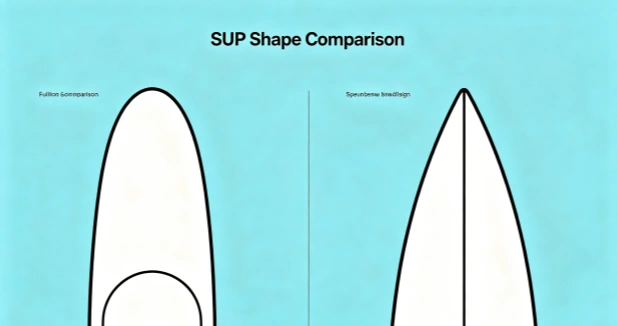
You can customize the outline of a paddleboard to suit your needs. All-around boards usually feature a rounded nose and tail for better stability, while race-oriented boards go with a pointed nose to slice through the water more efficiently. Generally speaking, the larger the board’s surface area, the greater its weight capacity. We’ve provided the following paddleboard shapes for your reference.
SUP PATTERNS
You can personalize your paddleboard with custom graphics tailored to your style. We use high-quality inks with both screen printing and UV printing techniques to ensure your design looks sharp, vibrant, and built to last. These inks are specially formulated to resist fading from UV exposure and withstand the harsh effects of saltwater.
SUP LAYOUT ELEMENTS
Deck Pad (Deck Grip Pad)
Position, size, and texture (e.g., diamond grip, wave pattern)
Whether it covers the full board or only the standing area
Carry Handle
Location, material (integrated or soft rubber), and whether it’s removable
Fin Box System
Single fin (US Box) or multi-fin setup (e.g., thruster 3-fin)
Compatibility with fins from different brands
Bungee Storage System (Elastic Cargo Area)
Elastic straps at the front or rear for securing water bottles, dry bags, etc.
Action Camera Mount
Typically located near the nose or carry handle; may include pre-installed GoPro mount
D-Rings / Tie-Down Points (D-rings / Cargo Attachment Points)
Number and placement (front, center, tail)
Used to secure gear, safety leash, seat, etc.
Logo & Graphics Placement (Branding & Design Layout)
Visual layout of logos and graphics on deck, bottom, and deck pad
Optional Add-ons (Optional Accessories)
Dedicated fittings for fishing rod holders, seat mounts, cup holders, etc.
Why Partner With Us?
Have a specific requirement or a unique market strategy?
Contact us today to discuss how we can tailor a SUP accessory package that fits your brand perfectly.